
Record Story #5: Analogija, Split 🇭🇷
Sobre este episodio
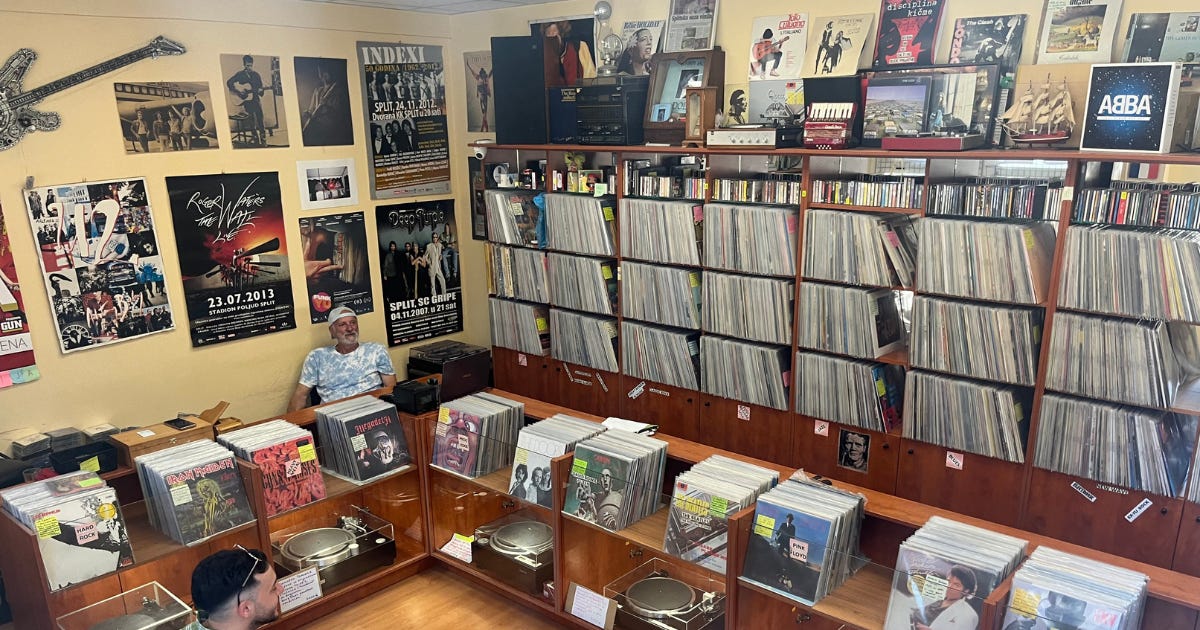
We met Žare outside the store in the scorching heat of a Split June. Its entrance is covered with a Stairway to Heaven mural, the Dark Side of the Moon prism, and pictures of Queen, The Beatles, Hendrix, and Jim Morrison. While we waited for his wife Zorana to join us, we talked about the store, music, and sports betting, a few days after Croatia’s 4-2 loss to England. Žare’s face lit up most when the conversation turned to music. They’d just seen Robert Plant at an old fortress in Šibenik, overlooking the Adriatic Sea. “He can still do it,” he said. “Some of these older guys, like Clapton, don’t have it anymore. But he still does.” I begged to differ, after my own recent Eric Clapton show in Kraków, and we spent a while trading concert stories. At one point, the conversation drifted briefly into politics. Žare said that there’s no room in his shop for the war or the old divisions, only music. I wasn’t planning on dwelling on past conflicts. As Zorana joined us, we continued the conversation on the record: Can we start with your backstory, how did you end up with the store? Žare: Thirty years ago, I had a small dream to open a vinyl store. Four years ago, that dream became a fact. I worked 43 years in a primary school as a teacher, and it was only after retiring that I finally opened it. Zorana: He says he had to open the store because it was some kind of deal between us: either open the store and bring all the records from the house into it, or get a divorce. But now I like them even more, and I’ve got my own collection at home. What are your biggest music inspirations? Žare: Always Pink Floyd, King Crimson, Frank Zappa, and Zeppelin, of course. My favorite song is “Stairway to Heaven,” from their fourth album. You mentioned you saw Robert Plant in Šibenik yesterday. Did he play “Stairway to Heaven”? Žare: Unfortunately, no. He played maybe three or four Zeppelin songs, but mostly new material, from his new album. How about you, Zorana? Do you have similar taste? Zorana: I like a few Zeppelin songs, but my favorite is Bruce Springsteen. We saw him in Vienna, I think two or three years ago, Žare, me, and our daughter. It was great. Were you always more into international music, or also into Yugoslav music? Žare: Both. My taste leans more international, all the rock, blues, jazz. But if you ask me which artists sell best in the store, it’s completely equal, half ex-Yugoslav bands, half international. Zorana: Yes, but you personally lean more international, even when you were younger. But we had a few great bands in ex-Yugoslavia in the early ‘70s that I love. Korni Grupa, Time, September, Indexi, Bijelo Dugme, which Polish people also love. When you were younger in Yugoslavia, was it easy to get Western records? Žare: Here’s how it worked. We couldn’t just walk into a bank and pay 10 English pounds for a record. We ordered through the UK’s Cob Records, Virgin Records, and Tandy’s Records, but if the state caught us doing that, we could get two years in prison. Sending dollars or marks out of Yugoslavia was a serious crime under the law at the time, prosecuted by the state. So we mailed 10 pounds inside postcards, and we had arrangements with a few workers at record shops and pressing plants in the UK. That’s how we got our vinyl. Zorana: Tell them about the Mexican music. People listened to Mexican music because it had no political weight, it was about love, simple things. Žare: It was easier to let people listen to that than to something progressive. In ‘59 the Party decided that all young people in Yugoslavia should prefer Mexican music. It was a Party decision. So no Western music was pressed in Yugoslavia at all? Žare: Very rare. But we had a few things, like A Nice Pair , first and second album of Pink Floyd, Zeppelin’s third album, and the Beatles. During the ‘60s there were several Beatles editions, later some Queen, some Doors, but not much. So your own taste is reflected in what the store stocks? Žare: Yes, of course. Zorana: He also has to stock everything else, because people ask for it. When we started we had a little electronic music, maybe a little punk or house. Now he carries more electronic because people ask for it, we don’t know much about it, but you have to have it. Metal, black metal too. Did you start with the store, or were you also selling at markets? Žare: Yes, we still go to several fairs every year, especially one in Podgorica, the capital of Montenegro. Everyone from ex-Yugoslavia goes, Serbia, Novi Sad, Belgrade, Macedonia, Bosnia and Herzegovina, Zagreb, Split, Croatia. Zorana: But the best fair is here in Croatia, in Imotski, about an hour from here. Every summer they run a three-day vinyl festival. We go every year, sell records in the evenings, and there are DJs playing off vinyl. Sometimes they bring in famous Croatian performers to play their own music. Great fair, great DJing. Since you’re a bit outside the old town, do you get a lot of tourists, or mostly locals? Zorana: We get tourists even though we’re away from the center, probably people find us online. Not huge numbers, but they come. Locals come too, but in summer we actually get more foreigners, maybe because locals go on vacation. Do you see a lot of younger customers in Croatia? Zorana: Yes, plenty. We get kids from maybe sixth grade, around 12 years old. They start listening because they got a turntable or some records from their grandparents, and then they come and buy. Žare: Our youngest customer is 7, we have another who’s 9. They pick out Iron Maiden, Guns N’ Roses themselves, with their parents’ permission, standing right there. You mostly stock second-hand. Are people interested in new music too? Zorana: Especially the young buyers, they want Lana Del Rey, Ariana Grande, Kanye West, Kendrick Lamar. Older customers mostly want the second-hand stuff. Do you see the new generation getting into Yugoslav records too? Žare: Yes. We were surprised to find that some foreigners who come in already know Azra, Bijelo Dugme, and buy ex-Yugoslav records. I’ve read that the pressing quality from Yugoslavia was very good compared to elsewhere. Žare: Yes, especially during the oil crisis, from around 1972 to 1979. We had very good vinyl quality, mostly 160 grams. Jugoton, based in Zagreb, had the best of it. It ran until Yugoslavia collapsed in 1991, and some of its pressing equipment was sold off to Czechoslovakia and, I believe, part of it to London. Can you tell us about how you source records? Žare: I do my best with colleagues across ex-Yugoslavia, different republics, different states. Mostly Serbia and Montenegro, sometimes Bosnia and Herzegovina. We’re a very small community, but very honest people, I call them friends. We trade, and when I’m missing something, they try hard to find it for me. That’s how it works. Are records from all the ex-Yugoslav countries popular in Croatia? Žare: Yes, but everyone knows what happened here during the war. Some people in Croatia hate certain artists just because they’re Serbs or Muslims. That’s not allowed in my store. That’s b******t. Zorana: I don’t fully agree. Personally, I wouldn’t stock some Serbian records, like Riblja Čorba. Bora Čorba was a terrible guy, he said terrible things about us during the war. It was a long time ago, but it’s still fresh. Žare: I see it differently. A few great artists, like Đorđe Balašević from Vojvodina and Rambo Amadeus from Montenegro, distanced themselves from the Milošević regime early on, before the war even started in the early ‘90s. But none of that is about the music, and I hate mixing the two. I have issues with some artists for being Chetniks or nationalists in their politics, but I try to keep music and politics separate, and I try to be fair about it. Zorana: But if they sing about those politics directly, I can’t separate it. That’s the problem. Maybe it’s because I’m younger, not as wise as him. Are there bands not internationally known that you’d recommend to readers? Žare: From the golden era of Yugoslav prog rock: Leb i Sol from Macedonia, Korni Grupa from Belgrade, Time from Zagreb, September, and a few others. In the early ‘70s we had a handful of excellent prog rock bands, we’re very proud of them. Indexi, of course, from Sarajevo. Bijelo Dugme, from Sarajevo too. Sarajevo gave us so much, Zabranjeno Pušenje as well. For my generation, Bregović’s the most recognized name from ex-Yugoslavia, partly because of the record he made with the Polish artist Kayah. Is he seen as more of a commercial artist here in the Balkans, or still well respected? Žare: Like I said, it depends on taste here, and mostly people lean prog rock. Goran Bregović always knew how to sell his music, and that’s why he’s famous worldwide, but not necessarily the best. Which city is the best for record shopping today? Žare: Belgrade. It’s a city of maybe 2 million people, with around 20 record stores. Zagreb has maybe 8 or 9 now. In Split there’s just us and Dancing Bear, but they mostly focus on new records, a different kind of shop, different music, different politics. If you could travel to shop for records anywhere, what’s your favorite city? Žare: The Netherlands, near Den Bosch, there’s the biggest record market in Europe, maybe the world. Maybe one day. Zorana: One client from the US also told us that Nashville is amazing. Do you see the same growing interest in vinyl here as in the rest of Europe? Žare: Yes. Vinyl’s come back. In our language, “vinyl” is a feminine word, my wife pointed that out, and she beat the CD and came back from the grave for revenge, and now reigns supreme. Interest in vinyl keeps growing, prices too, and a lot of young people get infected, addicted, and start their own collections. We talked before about you liking a bit of sports betting. How’s betting on records? Have you bought anything you thought would really go up in value? Žare: Everyone in our little community tells me that new pressings push prices down. I think the opposite, a new edition just as often helps the value of the original first pressing hold or grow. I started with 3,000 records, and what’s left at home now is mostly Krautrock from Germany, 1968 to 1975: Can, Amon Düül, over 150 records, all original first pressings. King Crimson, prog rock from the ‘70s, Frank Zappa, over 100 of his records altogether. Zeppelin, Beatles, Stones too. We’ve got one here, a Đorđe Balašević record, Marim ja... (”I Care...”), from 1991, that’s gone up to 1,000 euros. Zorana: He’s got the record, the CD, and the cassette of that same album, and it’s locked under key. You’ve also got some excellent hi-fi equipment here. Žare: I’m proud of my turntable collection, mostly from Japan, in excellent condition. Only one is belt-drive, an old Thorens TD-850. Everything else is direct-drive. I have a few contacts who source them from Japan, we upgrade them, put on a new cartridge, a new needle. Zorana: I told him, if he doesn’t sell that Kenwood, or that Yamaha, we should just take it home. He writes little cards for the turntables, and for the records too, everything about them, the year, the condition, by hand. Žare: That’s the one thing I’m really proud of. I’ve seen a lot of people selling records across Europe, and I think I might be the first to handwrite notes like that. Zorana: He spent months doing that. It helps a lot, especially for someone who doesn’t know much about a record, they can read the card and understand what they’re looking at. Žare: Every one of them has its own story. This Yamaha GT-2000L, with a special tonearm, I spent two or three years looking for it. I found a seller with two nearly identical units, one a GT-2000 and one the L version with the slightly better setup, and I ended up buying both. Long story. Can you tell us more about the community side? I saw you’ve organized some events or concerts? Zorana: Not as a shop directly, no, but we cooperate with others. A few DJs run evenings at cafe bars, they invite someone to play, and we bring the records. It’s happened a handful of times. Whenever someone asks us to cooperate, we say yes. In Split there isn’t really a vinyl lovers’ association like there is in Podgorica, Montenegro, where they get funding from the city. We don’t have that here, unfortunately, not from the city or the state. Maybe we should push for that, get support from the city and organize more gatherings and fairs. In the future, maybe. Any future plans for the store? Zorana: My plan is to find a way into a bigger market in Split, if I can find the right partners here. We’re also planning to start selling online, on Discogs, for example. Does checking Discogs affect what you can charge? Žare: People compare prices there, but it’s not binding. I don’t just follow Discogs, I price things on my own knowledge. If a buyer wants more records, we can always negotiate. Some records aren’t just objects, they carry emotional value, and I price accordingly. Subscribe to not miss the next one! A few more pictures, an Instagram reel, and a last dig through the crates. I’d asked Žare to pick a handful of Yugoslav 7”s that could fit in my small backpack. He handed me a great Rani Mraz single, “Računajte na nas,” and a beautiful copy of Teška Industrija’s “UFO / Karavan,” with a silver locomotive on the inner sleeve. He refused to let me pay for any of it. Instead I walked out with a T-shirt of Split’s own vinyl-wielding Bishop Gregory, which I’ll proudly wear around Barcelona. After two hours, Žare mentioned, in the nicest way possible, that he was getting a bit tired of talking in English. Zorana said he feels just as tired after long calls with his American cousin. Those two hours flew by. Talking to both of them was a real window into vinyl culture in Croatia, and a little trip back in time to Yugoslavia. If you also want to go on a journey to the land of Tesla and Kusturica, Žare’s album picks below are the best place to start. This is a public episode. If you would like to discuss this with other subscribers or get access to bonus episodes, visit digginit.substack.com